
 ES
ES  EN
EN 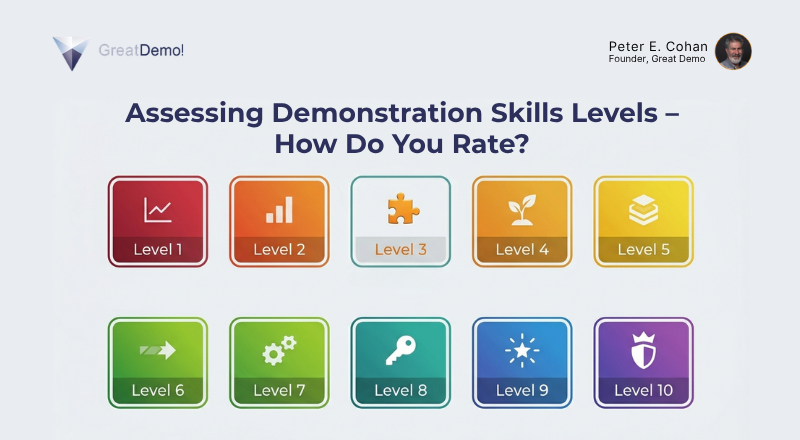
No dejar nunca de aprender Artículo
¿Qué hay en este artículo para usted?
- Evalúese a sí mismo y a su equipo
- Diez niveles de habilidades de demostración
- Exploración de las características de cada nivel
- Medidas para alcanzar cada nivel
- Pros y contras de las demostraciones de cada nivel, más calificaciones
- En significativo gains enjoyed by advancing through the skills levels
Un jefe de preventa comentó: "¡No saben lo que no saben...! 50% de nuestras oportunidades de venta acaban en "no decisión" y 30% de nuestras demostraciones son puro desperdicio. Debemos pasar de nuestros enfoques tradicionales a una metodología validada y probada que ofrezca mejores resultados".
He aquí un método sencillo para evaluar su situación y la de su equipo, basado en diez niveles de competencia creciente en habilidades de demostración:
Nivel 1: Sigue el guión de demostración estándar
Level 2: Customizes based on prospect’s market/industry
Level 3: Customizes based on discovery information uncovered
Level 4: Communicates tangible business value
Level 5: Applies both Vision Generation and Technical Proof Demos
Level 6: Manages and explores prospect questions
Level 7: Uses Biased Questions to outflank competition and reengineer vision
Level 8: Applies storytelling techniques to reinforce key ideas
Level 9: Applies these skills to the broad range of demo scenarios required, including demos for prospects occupying different portions of the Technology Adoption Curve, presenting new products, Executive Briefing Centers, transactional sales cycles, expansion opportunities, lunch and learn sessions, tradeshows, demos for analysts and third parties, channel partners, internal demos, and other scenarios
Level 10: Captures and reuses demo success scenarios, and integrates, aligns, and leverages the skills above into a cohesive demonstration methodology
¿Dónde se encuentran usted y su equipo en este espectro?
Most people and teams, when they are honest with themselves, are operating at Levels 1-3 (and Level 3 is often debatable…). That leaves a lote of room for improvement! The average vendor suffers from a ~45% Sin decisión rate and finds that ~35% of their demos are desperdiciado. If those numbers are similar to your experiences, then perhaps a change is in order! And even if your metrics are better, we should todos constantly seek to advance our skills.
What are some pathways to improvement? Libros are a terrific starting point, providing self-paced learning. However, you cannot have a conversación with a book (or a video), so answers to your questions or clarification of ideas have to come from somewhere else. Book clubs can be a mechanism to address this, but you are still at risk of the blind leading the blind!
Seminars and webinars provide the means to introduce new ideas and catalyze the process of change. These sessions are wonderful ways to kick off new programs and embrace large populations at once.
Talleres provide the strongest tactic to achieve substantive change. Workshops include multiple rounds of roleplay, where participants prepare and deliver new demos applying the methodology. Each round builds upon the previous and includes personal feedback, tuning, and guidance.
Elige el mecanismo que más te convenga. Ahora, exploremos cada nivel más de cerca...
Level 1 – Follows the Standard Demo Script
Most presales, sales, and customer success new hires go through basic training on their company’s products and systems, along with introductions to their go-to-market and sales process steps. For presales, customer success, and some salespeople, this includes learning the basic “standard” demo for each product they will represent.
A continuación, muchas organizaciones comprueban si el nuevo miembro del equipo domina estas demostraciones estándar mediante juegos de rol de certificación. Ese es el Nivel 1, que suele centrarse en garantizar que el empleado comprende las distintas capacidades de su software y el posicionamiento pertinente.
These standard demos are generally structured in a linear flow that includes presenting navigation, setup and customization options, various workflows, and reporting (if time allows!). They are not optimized for any specific prospect or demo scenario, and they are definitivamente not focused on the interests of specific job titles or adjusted for any markets or verticals. Disturbingly, any relevant discovery information is ignored, as well!
These demos are commonly known as stunningly awful Harbor Tours.
They are woefully ineffective. They fail to inspire vision; they fail to achieve technical proof; they suffer deeply from Recompra; and they are the recipients of countless painful jokes from prospects, customers, and more experienced vendor teams.
Amusingly, they are celebrated by the competitors of the vendors who present these Harbor Tours!
Generally, (hopefully!) there is an expectation that vendor practitioners will only use these standard demos as a starting point. Unfortunately, many team members continue to follow these same unproductive demo pathways for years…! (Visualize a mass of lemmings marching unconcernedly towards a cliff.)
Medida(s) para alcanzar el Nivel 1:
- "Certificación" por parte de un directivo, un equipo de certificación, un mentor o un colega.
Pros:
- Proporciona a los profesionales una comprensión de las capacidades de su software.
Contras:
- ¡Únete a la población de impresionantes Harbor Tours!
- Inadecuado para la generación de visión.
- No apto para conseguir la Prueba Técnica.
- Demos are generally a monologue.
- Unbelievingly boring!
- Suffers from severe Recompra.
Calificación (para demostraciones a la mayoría de prospectos): F
Level 2 – Customizes Based on Prospect’s Geo/Market/Industry
What’s important about +1, +49, +44, +33, +91, etc.?
The first small step towards customizing demos to meet prospects’ specific situations is often reflected in the use of market- or industry-specific data sets and vocabulary. This can be as simple as using an adaptive or pre-built entorno de demostración for each industry: manufacturing, finance, pharma, etc. In the absence of adaptive or pre-built environments, practitioners can modify data themselves and apply appropriate terminology in their verbal delivery during demos.
Another dimension at this level of customization is adapting the demo to meet the specifics of a geographic region, which might range from including regional addresses or phone syntax, job titles and local terminology, to verbal delivery using the prospect’s local language (e.g., like Californian, dude!).
Medida(s) para alcanzar el Nivel 2:
- Realiza los cambios oportunos en los datos de la demostración y la entrega verbal.
Pros:
- Muestra cierta sensibilidad hacia la regionalidad y/o los mercados.
Contras:
- ¡Un Tour del Puerto nominalmente mejorado (sección de asientos preferentes)!
- Sigue siendo inadecuado para la Generación Visión.
- Sigue siendo inadecuado para conseguir la Prueba Técnica.
- Demos are still a monologue.
- Still suffers from severe Recompra.
Grade (for demos to most prospects): D-
Nivel 3 - Personalización basada en la información descubierta
Wait, what? You want descubrimiento information antes de presenting the demo?
¡Sí, por favor!
Esto requiere tres pasos para completarse:
- El descubrimiento debe ser hecho.
- La información de descubrimiento debe ser comunicado (if it isn’t the same person doing discovery and the demo).
- La información de descubrimiento debe ser incorporado en la demo.
¿Suena obvio? Lamentablemente, he visto innumerables demostraciones en las que:
- El descubrimiento nunca se hizo o fue insuficiente para influir en lo que se mostró en la demo.
- El descubrimiento se hizo (por otra persona), pero nunca se comunicó al presentador de la demostración.
- El descubrimiento se hizo pero fue ignorado en la demostración resultante.
Muy sencillo, descubrimiento suficiente provides guidance on which capabilities to include in the demo and which capabilities to omitir. If your team’s demos follow the same path regardless of what was learned in discovery, then they haven’t achieved Level 3.
An observation: It is incredibly insulting to prospects who have invested time in a discovery conversation with a vendor to have that vendor ignora la información sobre descubrimientos facilitada
Medida(s) para alcanzar el nivel 3:
- Sufficient discovery is done, as measured by a completed GREAT DEMO! Situation Slide.
- La información sobre el descubrimiento se comunica a todo el equipo de ventas.
- Demonstrator presents or no present capabilities in alignment with the discovery information collected.
Pros:
- Representa un punto de inflexión entre las demostraciones infructuosas y las exitosas.
- Puede ser suficiente para obtener la Prueba Técnica.
Contras:
- Sigue siendo inadecuado para la Generación Visión.
- Sigue siendo en gran parte un monólogo.
- No se comunica el valor empresarial.
Grado: C
Nivel 4 - Comunica el valor empresarial
The number one complaint from presales, sales, and customer success leaders about their teams’ demos is that “they don’t communicate business value…” And in order to communicate business value, teams need to know what the value es for their prospects!
Se trata de un nivel de habilidad decisivo. Los que no sepan comunicar el valor empresarial tendrán problemas con sus demostraciones; los que transmitan un valor tangible estarán en posición de triunfar.
Most vendor demos don’t communicate valor at all, leaving prospects without the ability to sell internally. Some vendors describe generic value, and a subset of these vendors go further to make it tangible. However, the real objective is to communicate the tangible value gains for each específico prospect. Let’s break these important ideas down!
Valor empresarial genérico:
Case 1: In the simplest case, presales, sales, and customer success teams should be able to articulate the intangible benefits of their solution. This might be phrased as, “Our software enables you to reduce the time needed to…” Frankly, this is too generic and, accordingly, it is nearly meaningless.
Case 2: Slightly better is to communicate the kinds of tangible gains seen across the industry, “Our customers report savings of 2-4 weeks in process time…” But will this resonate with the current prospect? Hard to say…!
Case 3: An additional improvement is to be more specific, “Other customers who are very similar to you report process reductions of 2-3 weeks…” This will feel more relevant for the current prospect but note that the numbers are de otra persona.
Valor empresarial específico:
A falta de descubrimiento, los vendedores se limitan a declaraciones de valor genéricas. En consecuencia, el descubrimiento debe llevarse a cabo con el claro objetivo de descubrir elementos de valor significativos y específicos de los clientes potenciales.
During discovery, any time your prospect “admits pain,” your job is to quantify it. Each of these is a Delta: the difference between your prospect’s current state and their desired future state. While the concept of capturing and communicating Deltas is richly developed in both Descubrimiento y GREAT DEMO!, here is a brief introduction:
Cuando tu cliente potencial te diga: "Tardo demasiado...", tu respuesta debe ser en forma de dos preguntas:
- ¿Cuánto tarda hoy?
- How long debe it take?
The difference is the Delta: A simple and direct expression of value. A few additional questions will enable you to do the math (“maths” for you in the UK, etc.) to calculate meaningful business value statements.
Ejemplo:
Prospect afirma: "Tarda demasiado...".
Usted pregunta: "¿Cuánto tarda hoy?".
Su cliente potencial responde: "El proceso completo tarda actualmente 10 días laborables...".
You enquire, “And what would you like it to be – what does it necesita to be?”
El cliente potencial responde: "Tenemos que reducirlo a 2 días laborables".
Y tú sigues con: "¿Y con qué frecuencia realizas este proceso?".
"Cada dos semanas - 25 veces al año..." es la respuesta.
Luego preguntas: "¿Y cuántas personas se consumen hoy en este proceso?".
Prospect responde: "10 funcionarios, es su única función".
So, this prospect could redeploy 80% of their team to other, more valuable tasks. That’s 8 FTE (Full Time Equivalents). Eso es the Delta. And that represents the driving force for making the change.
The 8 FTEs is the tangible and specific value of making the change for this prospect. At Level 4, this information is communicated and reinforced throughout the demo.
Metas, objetivos y resultados:
Finally, Level 4 practitioners uncover prospects’ overarching business goals and objectives, in discovery, and align their discussion of business value with these goals and objectives. These are called Cuestiones empresariales críticas.
In the example above, when we identified the specific business value for a particular process, the Level 4 practitioner would también ask, “Por qué do you need to improve your process – what is your objective for this project?” The prospect’s response might be, “We’ve been tasked to increase our overall productivity by 10% and this process was identified as a key problem area…” The Critical Business Issue is “Increasing productivity by 10%” and we include this in our discussion of business value during the demo.
In Great Demo! methodology, we document the prospect’s Critical Business Issue(s) así como the Delta (the specific business value) on the Situation Slide, we revisit these when we present Illustrations, and we include them in our Summaries. Consistent, precise communication of business value is a critical success factor for demos and can be a major point of differentiation between vendors!
Medida(s) para alcanzar el nivel 4:
- Presenta métricas de valor empresarial tangibles y específicas para cada cliente potencial.
- Vincula el valor de negocio a la(s) Cuestión(es) Crítica(s) de Negocio.
Pros:
- A menudo es suficiente para lograr la Prueba Técnica.
- Permite a los clientes potenciales crear casos de negocio internos.
Contras:
- Sigue siendo inadecuado para la Generación Visión.
- Puede seguir siendo un monólogo unidireccional.
- May be difficult to differentiate from competition.
- Puede dejar dinero sobre la mesa.
Calificación: B
Nivel 5 - Se aplica tanto a la generación de visiones como a las demostraciones de pruebas técnicas
How often are you asked to provide an overview demo to a sales qualified lead that goes nowhere? How frequently does it seem that prospects who ask for demos are just planning for the future, and have no intention of buying in the short term?
The ability to differentiate between prospects who are “Just Browsing” vs in an “Active Buying Process” is another major skills watershed. Those who are unable to make this determination are doomed to long sales processes that far too frequently end in No Decision outcomes (or their sales processes nunca end and are on the forecast forever!).
Prospects who are Just Browsing are doing exactly that: They just want a taste of your capabilities, not a seven-course banquet. These prospects are often in the early stages of exploration or planning for their next fiscal year. The don’t want to engage, yet, in a sales process. How do you satisfy them?
You deliver a Vision Generation Demo!
These use Éxitos informales combined with a algunos key software screens – often dashboards or reports – to build a vision of what is possible in your prospects’ minds. A complete Vision Generation Demo can be executed in ten minutes or less, satisfying these prospects while avoiding the horrors of Rotación de clientes potenciales.
Prospects who are in an Active Buying Process, on the other hand, may want a Vision Generation Demo to kick off their investigation process, followed by substantive discovery and Technical Proof Demos. How do you determine your prospects’ level of interest? You pregunte a!
(Chapters 4-9 in the Third Edition of GREAT DEMO! provide the complete recipe for Technical Proof Demos and Chapter 11 details the formula for Vision Generation Demos.)
Medida(s) para alcanzar el nivel 5:
- Diferencia las perspectivas de mera navegación de las de proceso de compra activo.
- Presents Vision Generation Demos when appropriate.
- Bonus: Applies the Enfoque del menú as a lead-in for Vision Generation Demos.
Pros:
- "Menos es más" Las demostraciones de la Generación Vision satisfacen los deseos de muchos clientes potenciales.
- Productively recycles many leads that would otherwise have churned.
- Permite a los campeones y a otras partes interesadas vender internamente.
Contras:
- May be difficult to differentiate from competition.
- Puede seguir siendo un monólogo unidireccional.
- Puede dejar dinero sobre la mesa.
Nota: B+
Nivel 6 - Gestiona y explora las posibles preguntas
Existen three parts to this level:
- Evaluar y gestionar el flujo de preguntas.
- Exploring the intent detrás de preguntas de los prospectos.
- Encouraging an actual conversación to take place!
Let’s start with the third item on this list…
You may have noted that many of the previous levels suffered from a high risk of vendor monologues. This is very typical for practitioners operating at the lower Levels! These reps are eager to pack as much info into their demos as time allows, which reduces or eliminates the possibility of prospect questions or feedback.
A classic indicator of monologue delivery is the following frequently repeated exchange:
"¿Alguna pregunta hasta ahora?"
“Nope, we’re good.”
“Peeling Back the Layers” in Great Demo! methodology is all about encouraging a productive, bidirectional conversation to take place. Prospects that actively participate in the demo, through inquiry and commentary, are mucho more engaged and are mucho more likely to retain the key ideas presented, particularly if it was their questions that drove the discussion!
Bien, ahora que estamos fomentando activamente las preguntas, volvamos a cómo gestionar el flujo.
Achieving the number 1 above is a dynamic process of determining, “Is this something I need to answer now, or should it be deferred until later?” The use of a questions Parking Lot is an indicator of gestión eficaz de las preguntas. (See Chapter 8 in the Third Edition of GREAT DEMO! for details on this process.)
Far too many demos are diverted in the first few minutes by prospect questions that drag the presenter into the weeds. Innumerable prospect executives have left demo meetings early because of lengthy, detailed explanations by vendor reps thrashing further into the underbrush!
I’d be an extremely rich person, monetarily, if I had a dollar for every time a vendor provided protracted paragraphs of answers to questions that only needed a crisp “Yes” response! (Please take up a collection for me.)
Number 2 above is exploring the por qué behind prospect questions. Is the question being asked in earnest vs a “I’m just curious?” Is it a “landmine” planted by a competitor? Does it represent the need for a “KO” capability vs a less important “nice to have” feature?
¿Cuántas veces hemos oído a un cliente potencial preguntar: "¿Puede su software hacer X?" y el vendedor responde "¡Por supuesto! Déjeme que le muestre cómo funciona..." o "No, pero tenemos una solución... aquí se la mostraré..." sin ninguna pregunta recíproca?
In both cases, the vendor missed an important opportunity to seek clarification.
"¿Qué importancia tiene esto para ti?"
"¿Qué motivó su pregunta?"
"¿Qué necesita conseguir con este tipo de capacidad?".
"¿Con qué frecuencia se utilizaría?"
Prospect responses to these questions can make or break a demo. Skilled question management can keep you out of the weeds, enable you to identify and categorize prospect needs and wants, and address competitive threats while simultaneously encouraging the conversation.
The Level 6 practitioner manages and investigates prospect questions thoughtfully!
Medida(s) para alcanzar el nivel 6:
- Achieves a Talk:Listen ratio of 50:50 or better (larger “Listen” numbers are better).
- Aplica los principios del aparcamiento.
- Hace preguntas aclaratorias.
Pros:
- Enables a true conversación que tenga lugar.
- Mejora la retención de las ideas clave.
- Descubre y aclara cuestiones de prospección no abordadas en la presentación de pruebas.
Contras:
- May todavía be difficult to differentiate from competition.
- May todavía leave money on the table.
Nota: B+
Nivel 7 - Utiliza preguntas tendenciosas para flanquear a la competencia y rediseñar la visión
Achieving Level 7 is a major step! Most presales and salespeople are completely sin saberlo of the use of Biased Questions and Vision Reengineering concepts.
In traditional demos, vendors endeavor to show as much functionality as time allows, regardless of whether that functionality is meaningful or relevant for the prospect. In Great Demo! methodology, you learn how to present exactamente the capabilities the prospect needs, based on discovery.
But what if you realize, during the demo, that there are features your prospect debe need or want, that you hadn’t discussed during discovery?
How do you introduce those capabilities, but without the risk of flogging your prospect with unwanted features and Recompra? You use a Biased Question!
A Pregunta tendenciosa leads your prospect towards a logical conclusion, such as the need for your competitively advantageous capability. In these cases, the capability is introduced verbalmente, and then shown only when the prospect agrees that it would be useful and wants to see it.
The Level 7 practitioner has a store of Biased Questions ready to deploy (both in discovery and demos) and introduces them when appropriate. (Biased Questions are covered in both GREAT DEMO! y Descubrimiento, in alignment with presenting demos or engaging in a discovery conversation.)
A continuación, la reingeniería de la visión es otro conjunto de competencias avanzadas relativamente desconocido, pero esencial.
Most prospects “don’t know what they don’t know” about your offerings’ capabilities. Their knowledge, prior to a discovery dialog or a demo, is generally limited to what they can learn online. It is rare that a vendor lists todos of their capabilities publicly, to keep competitors in the dark (and often because a complete listing is impractical, if not unreadable!).
Vision Reengineering is the process of helping your prospect expand their concept of a solution to embrace a broader set of your offering’s capabilities.
¿Un ejemplo?
Imagine the difference between a prospect’s current deliverable of a static report vs a dynamic dashboard with live “slicing and dicing” and drill-down capabilities. The prospect may not realize that such a dynamic dashboard is even posible. In Vision Reengineering, the vendor introduces the capability using a Biased Question that describes how other, very similar customers utilized the dynamic dashboard to improve and increase the value of the solution.
En medio de una demostración, la funcionalidad se muestra si el cliente potencial está de acuerdo en que la desea. En una conversación de descubrimiento, si el cliente potencial decide que desea la funcionalidad, esta se convierte en una funcionalidad específica que se mostrará en la siguiente demostración.
Las preguntas tendenciosas son utilizadas con frecuencia por los representantes de nivel 7 para impulsar las conversaciones sobre la reingeniería de la visión.
¿Por qué son tan importantes las preguntas tendenciosas y la reingeniería de la visión? Por dos razones principales:
- Evita dejar dinero sobre la mesa.
- Permite la competencia de flanqueo.
Cuando amplía con éxito la visión de sus clientes potenciales sobre una solución a través de la Reingeniería de Visión, a menudo está construyendo una solución mayor y más completa. A menudo incluye productos o servicios adicionales para la venta que aumentan el valor de la solución y el tamaño de la oportunidad de venta.
Del mismo modo, la reingeniería de la visión es un arma competitiva. Cuando un cliente potencial adopta una solución más amplia o profunda que incluye capacidades de las que carece su competencia (o adolece de insuficiencias), usted está estableciendo una diferenciación competitiva.
Aplicar preguntas tendenciosas y ejecutar hábilmente la reingeniería de la visión puede inclinar la balanza competitiva a su favor y aumentar el tamaño del pedido. ¡Un placer!
Medida(s) para alcanzar el nivel 7:
- Utiliza preguntas tendenciosas.
- Amplía y establece la Visión de Reingeniería para los prospectos.
Pros:
- Permite la competencia de flanqueo.
- Puede aumentar el importe de la compra.
- A menudo mejora la solución consumida por el cliente.
- Reduce las posibles bajas.
Contras:
- Las demostraciones pueden seguir siendo comparativamente áridas y poco estimulantes.
Calificación: A-
Nivel 8 - Aplica técnicas narrativas para reforzar ideas clave
Next to “communicating business value” storytelling is the most frequent demo skills improvement sought by sales and presales managers. But just “wrapping a story around your demo…” is not a simple or effective solution. Successful Cuentacuentos tiene que ver con la comunicación pegajosidad and the ability for your prospects to remember – and retell – your key messages.
Similarly, “A Day in the Life” demo is no an effective story. It’s just a framework and is not compelling on its own.
Level 8 practitioners use stories when presenting their most important points, critical concepts and key competitive capabilities. Stories help make these ideas memorable, enabling prospect players to retell those same stories with high fidelity within their own organization.
Stories about how other, similar customers successfully used your capabilities to address their challenges are engaging and stimulate interest: They generate hope and curiosity, “If ellos could do it, then we probably can as well – and I wonder how they did it?” This is where you harvest and apply Éxitos informales in your demos.
Stories don’t need to be Norse sagas! Sometimes, simple is better.
Never tell a good story once! When you find stories that resonate strongly, practice retelling these to tune and mejorar your delivery and their impact. (See Chapter 14 in the Third Edition of GREAT DEMO! for a complete treatment of storytelling in demos.)
Medida(s) para alcanzar el nivel 8:
- Utiliza relatos estructurados para apoyar capacidades o conceptos clave.
- Bonus: Prospects volver a contar your stories internally!
Pros:
- Hace que sus demostraciones sean especialmente notables y memorables.
- Permite a los campeones volver a comunicar eficazmente las ideas clave.
Contras:
- Requiere una amplia experiencia personal o un repositorio de historias de equipo.
Grado: A
Level 9 – Applies These Skills Across the Broad Range of Demo Scenarios
Una de las ideas clave de la metodología Great Demo! es que no existe "una demo para todos los prospectos".
A basic Great Demo! principle is to align your demo with each of your prospect’s specific job titles. A CRO has different requirements than a VP of sales, whose needs are different from the those of front-line managers, who also have distinct requirements vs their salespeople staff. Add presales players to the mix and you have another set of specific needs and wants. Include marketing, professional services, and customer success, and your complexity increases.
One demo does no fit all prospect job titles.
Similarly, there are differences across a broad range of other prospect dimensions that need to be taken into account in your demos:
- Curva de adopción de la tecnología: Each category has specific needs, desires, and differing willingness to accept risk. A technology demo (or painful Harbor Tour) may actually be preferido by some Innovators. Conversely, the Early Majority will want extensive discovery followed by fairly detailed demos of the functionality they plan to use. The Late Majority will require “comprehensive” demos as well deeper additional forms of proof (e.g., POCs and POVs).
- “Burn Victims”: These are prospects that suffered a failed implementation or the inability to achieve a predicted ROI. Discovery and demos for this group will require gaining a clear understanding of what happened previously along with demonstrated proof that these Burn Victims won’t endure the same result again.
- Executive Briefing Centers (EBCs): These demos need to educate prospect leadership and staff about possibilities and solutions for the future. They leverage Vision Generation Demos, the Enfoque del menú, and often include substantial Vision Reengineering.
- New Products and New Categories: Success with these demos requires a clear understanding of the Curva de adopción de la tecnología as it applies to discovery and demos.
- Transactional and High Velocity Sales Cycles: How do you execute sufficient discovery and deliver compelling demos in a highly transactional mode?
- Expansion Opportunities: How do you leverage your position as the proveedor titular a expand your solution footprint?
- Almuerzo y formación Sessions: What is the best way to execute Lunch and Learn demos and similar events? Skilled practitioners find success applying the Menu Approach and Vision Generation Demos for these opportunities.
- Tradeshows: The perfect environment to apply the Menu Approach and Vison Generation Demos!
And that’s just the visible portion of the iceberg. You can (and should!) apply Great Demo! principles and skills for demos to internal players, third parties, and analysts. Vendors that sell through channel partners or resellers represent another dimension of application (several dimensions, actually!).
If you mentally revisit Level 1 where new hires are learning the “standard” demo, you’ll realize that this is where the trouble begins! Modifying your onboarding training to embrace Great Demo! and Doing Discovery practices will both accelerate time-to-competency and eliminate the need to retrain staff.
Putting it all together takes formación, experience, practice, and coaching. Read Un cuento de prospectos for a humorous, yet pragmatic story that illustrates what no to do and, more importantly, what success looks like (The last story in Suspender la incredulidad)!
Medida(s) para alcanzar el nivel 9:
- Aplica las metodologías Great Demo! y Doing Discovery en toda la gama de situaciones de demostración que se le presenten.
Pros:
- Se desenvuelve con soltura en un amplio abanico de situaciones de demostración.
- Reduce el tiempo de incorporación.
Contras:
- Requiere una amplia experiencia personal, formación y entrenamiento.
Calificación: A+
Level 10 – Captures and Enables Reuse of Demo Success Materials
Consider these competitively advantageous resources as “Demo Capital!”
While individuals can ascend to this level (and should!), this is really an organización objective. While one person can collect and leverage experiences, stories, and other demonstration capital and assets, contemplate what a team can amass with the appropriate guidance and support systems.
As presales, sales, and customer success practitioners mature, they recognize the importance of altruism and mutual enablement. Sharing what has worked and not worked with their peers generates a virtuous feedback loop, enabling individuals to tap into the broader experiences of the team.
These positive feedback loops often start informally with post-demo vendor team discussions of “What went well?” “What didn’t go so well?” and “What could we have done better or differently?” Formalizing this process to make post-demo reviews a structured, regular habit is a key indicator of Level 10 practice.
Éxitos informales are part of the lifeblood of an organization and are used by seasoned customer-facing folks as integral components of their processes. They provide the foundation materials for the Menu Approach, Vision Generation Demonstrations, Biased Questions, and Vision Reengineering.
Application often starts with a phrase such as, “Let me share how another customer, very similar to you, solved this…” The balance of the story (often a “Hero’s Journey”) describes how your customer’s challenges were overcome by using your offering.
Now, imagine a room of fifty presales, sales, and customer success team members at an annual kickoff meeting. Each person has been asked to document a customer success story that they personally experienced: just one story each. Fifteen minutes later they send those stories to an enablement person who organizes them into a library. Suddenly, everyone has forty-nine nuevo success stories to draw from and use in their sales and presales efforts.
That’s a nearly fifty-fold amplification effect in a quarter of an hour!
Additionally, these success stories are terrific examples of what good, well-qualified prospects look like, representing high product “fit” with respect to prospect needs and wants, enabling happier customers and reducing churn.
Next, collect and share particularly compelling Illustrations, successful Menus, Biased Questions and examples of Vision Reengineering. These valuable demo assets can and debe be leveraged to accelerate onboarding, upskilling, and advancing your team’s overall level of execution.
Organizations that achieve Level 10 enjoy remarkable amplification and acceleration of sales, presales, and customer success processes while rather dramatically reducing the number of wasted demos and No Decision outcomes. They become organizations that high-performing customer-facing people want to join!
Medida(s) individual(es) para alcanzar el nivel 10:
- Realiza revisiones periódicas y estructuradas después de la demostración.
- Envía historias de éxito informales, ilustraciones, menús y otros recursos de demostración a una biblioteca corporativa o de equipo.
- Bonificación por servir de mentor a otros.
Medida(s) organizativa(s) para alcanzar el nivel 10:
- Recoge los resultados clave de las revisiones periódicas y estructuradas posteriores a la demostración.
- Recopila, conserva y distribuye historias de éxito informales, ilustraciones, menús y otros recursos de demostración.
- Implementa y aplica circuitos de retroalimentación coherentes para impulsar una práctica constante de mejora.
Pros:
- Amplifica y escala a todo su equipo de atención al cliente.
- Genera, atrae, desarrolla y retiene personal de alto rendimiento, mentores y gestores de primera línea.
Contras:
- Requiere personal encargado de establecer, desarrollar y mantener procesos y sistemas de apoyo.
Grado de organización: A+
Nivel 10 - Consigue la plena implantación de la metodología
Methodology is an integrated, coherent suite of skills that interconnect, leverage and support one another, enabling process, playbooks, coordinated motions, consistency, tracking, measurement, and structured coaching. Methodology addresses four key questions:
- Por qué: por qué hacer las cosas de una determinada manera.
- Qué - qué debe hacerse.
- Cómo - cómo ejecutar habilidades específicas - instrucciones explícitas.
- Cuándo - cuándo aplicar las destrezas y en qué orden.
La metodología permite enseñar y practicar destrezas, tanto individualmente y as integrated components. In Great Demo! methodology, for example, Informal Success Stories feed Vision Generation Demos and associated Menus, supporting a variety of demo scenarios (including “just show me a demo” requests from prospects, Executive Briefing Center demos, demos for 3rd parties, and many more).
The application of the Pirámide invertida structure in Great Demo! delivery is another example of methodology vs individual skills, guiding us to present the most important content early in our demos, followed by inviting our prospects to Peel Back the Layers as deeply as they desire. The Inverted Pyramid arrangement tells us why, what, how, and when to present information in a demo.
Fascinatingly, the VP of Enablement of one of our Great Demo! customers noted that, “Methodology permite enablement…!” An insightful and provocative perspective!
Medida(s) para alcanzar el Nivel 10 - Aplicación de la metodología:
- Funciona como un equipo o una organización y no como individuos.
- Establece objetivos y realiza un seguimiento de los parámetros para mejorar el rendimiento y la eficacia del equipo.
- Evoluciona y ajusta activamente la metodología de acuerdo con los objetivos de la empresa, los cambios del mercado y la cultura.
Las organizaciones que alcanzan el nivel 10 de implantación de la metodología disfrutan de métricas de escalado y amplificación notables y establecen ventajas competitivas sustanciales frente a sus homólogas.
Diez niveles de destreza demostrativa
These Ten Levels, along with their metrics for attainment, provide you with a structured approach to assess and advance. So, now how do you rate yourself or your team? Has your assessment changed?
Nivel 1: Sigue el guión de demostración estándar
Level 2: Customizes based on prospect’s market/industry
Level 3: Customizes based on discovery information uncovered
Level 4: Communicates tangible business value
Level 5: Applies both Vision Generation and Technical Proof Demos
Level 6: Manages and explores prospect questions
Level 7: Uses Biased Questions to outflank competition and reengineer vision
Level 8: Applies storytelling techniques to reinforce key ideas
Level 9: Applies these skills to the broad range of demo scenarios required, including demos for prospects occupying different portions of the Technology Adoption Curve, presenting new products, Executive Briefing Centers, transactional sales cycles, expansion opportunities, lunch and learn sessions, tradeshows, demos for analysts and third parties, channel partners, internal demos, and other scenarios
Level 10: Captures and reuses demo success scenarios, and integrates, aligns, and leverages the skills above into a cohesive demonstration methodology
In the absence of this kind of analysis, most veteran presales and salespeople, when asked, would position themselves as “advanced” or “experto” in preparing and delivering demos. In fact, when I asked one head of presales about her team, she said, “Well, I’d say that only 20% of the veterans are really good – the others piense en son buenos, pero les queda mucho camino por recorrer...".
Copyright © 2021-2023 La Segunda Derivada - Todos los derechos reservados.
Para aprender los métodos presentados anteriormente, ¡considere la posibilidad de inscribirse en una Gran Demostración! Realización de habilidades de descubrimiento o demostración Taller. Para obtener más consejos sobre demostraciones y descubrimientos, mejores prácticas, herramientas y técnicas, explore nuestro librosblog y artículos en las páginas de Recursos de nuestro sitio web en https://GreatDemo.com y únete al Gran demostración y grupo de LinkedIn "Doing Discovery para aprender de los demás y compartir sus experiencias.