
 ES
ES  EN
EN 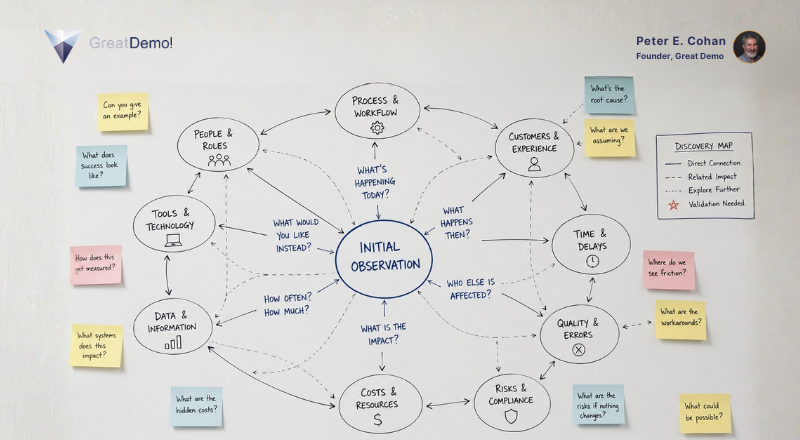
Your prospect admits, “It’s a manual process.”
You reply, “Does it typically go smoothly? What happens when someone is on vacation?”
“It’s a mess! We literally have tickets piling up on people’s desks…!” divulges your prospect.
Congratulations! You’ve just deepened and broadened your prospect’s pain using the essential discovery skill of Expansion Questions. So, what are they, how do you use them, and when?
Expansion Questions are a series of interrelated questions designed to span five of the seven discovery skills levels, from uncovering pain to reengineering vision. They are a simple, yet essential skill to master in doing discovery enabling you to extend, deepen, and quantify your prospects’ pains and related impacted areas.
Las Preguntas de Expansión aprovechan sus experiencias con otros clientes potenciales y clientes, proporcionándole listas de posibles áreas problemáticas, impactos y resultados que explorar con nuevos clientes potenciales.
Un ejemplo
Let’s return to the conversation above. A skilled vendor and their prospect are talking about the prospect’s current workflow that handles customer requests and issues. Let’s listen:
El cliente potencial comenta: "Es un proceso manual...".
El vendedor responde: "Siento oírlo, ¿qué pasa hoy?".
Prospect explains, “Well, each request is entered, reviewed, processed, escalated, and closed in a series of steps, with each step done manually by an individual, then passed to the next person in line.”
The vendor asks an Expansion Question, “Does it typically go smoothly? For example, what happens when someone is on vacation?”
El vendedor sabe, basándose en experiencias anteriores con clientes potenciales similares, que las vacaciones suelen tener graves repercusiones negativas en estos flujos de trabajo.
El cliente potencial responde: "¡Es un desastre! Tenemos literalmente billetes amontonados en las mesas de la gente...!".
El vendedor responde: "¿Qué pasa entonces?".
Prospect ofrece: "Como mínimo, provoca retrasos en el tiempo de respuesta, lo que repercute en la satisfacción del cliente".
Nuestro vendedor toma nota de que volverá sobre esta declaración de impacto más adelante, pero por ahora se centra en el tema actual:
Vendor asks, “I see… How many folks are involved on your team?”
Prospect says, “We have a total of 12 people doing this, and it is far too many!”
Vendor pursues, “Understood. And what would you like to reduce this to?”
Prospect states, “I’d love to get this down to two people. There’s plenty on the team’s plate that needs to be done in addition to this process!”
Note that our vendor has quantified a desired outcome – a Delta – reducing the number of people in the workflow from twelve to two. Next, knowing that manual processes typically result in errors, our vendor introduces another Expansion Question:
Vendor queries, “I see – how often do errors creep into your process today?”
Prospect declara: "¡Oh, todo el tiempo...!".
El vendedor amplía: "¿Y qué pasa cuando se producen errores?".
Prospect admits, “Well, we often have to go back, find the error, and then rework the downstream portion of the workflow. It can get pretty bad!”
El vendedor cuantifica: "Lamento oír esto: ¿con qué frecuencia ocurre y cuánto tiempo se tarda en corregir, de media, cada incidencia?".
Prospect notes, “At least once a week and it can consume hours to fix each one.”
Vendor offers, “And I’m guessing you’d like to reduce this to zero or near zero, if possible. Is that correct?”
El cliente potencial responde: "¡Por supuesto...!".
Note that our vendor has now quantified two aspects of the manual process, so far, capturing the prospect’s specific numbers. Our vendor then explores more impact through another Expansion Question, again based on experience with other prospects:
Vendor asks, “And what happens downstream? Who else is impacted?”
Prospect notes, “Oh, it ripples throughout the organization, resulting in sending the wrong patches, incorrect documentation for customer success managers, mistakes with our product roadmaps, inaccurate renewals forecasts, and the worst cases can result in very unhappy customers, which we know contributes to churn!”
Vendor asks, gently, “Do you get grief from these other teams, as a result?”
Prospect admite: "Sí, ha añadido mucha más presión para solucionar este problema...".
Vendor confirms and moves towards a discussion of solutions:
Vendor resumes, “I see. So, this is really impacting the organization broadly. Let’s change gears back to your current manual process: are you looking to automate this following the existing workflow or do you have any other changes in mind?”
Prospect dice: "Los pasos individuales están todos bien, sólo tenemos que deshacernos del trabajo manual y de las entregas físicas".
Our vendor realizes that the prospect is unaware of the range of possible solutions and expands using a Biased Question to explore Vision Reengineering with the prospect:
Vendor notes, “Interestingly, many of the other companies we’ve worked with found that the ability to both automate their workflows and implement AI rules-based processing and alerts not only eliminated the errors and handoffs but also resulted in dramatically reduced churn and increased renewals. Some of our customers report 10-20% less churn and 5-10% increases in renewals and add-on sales. Is an AI rules engine something that might also be useful in your practice?”
Prospect responds, “Wow, I hadn’t thought about that. Yes, that would be really cool! How does that work?”
Dejaremos la conversación en este punto y dejaremos que nuestro vendedor y nuestro cliente potencial continúen por su cuenta...
¿Estás dando testimonio?
Sí, absolutamente...
Expansion questions take advantage of your knowledge about other, similar prospects’ situations. Any time you know, from your experience, that another aspect of your prospect’s pain is likely, that’s a candidate for an Expansion Question.
He aquí algunos ejemplos lógicos:
- Manual processes: are likely to have errors which propagate and associated delays which probably impact others.
- Paper processes: are subject to similar issues, plus lost papers and transcription errors (what do these impact?).
- Email communications: may suffer from lost or ignored messages and vague assignments (what happens then?).
- False positives or false negatives: can represent a world of pain on their own!
- Poor CRM hygiene: results in false forecasts, pipeline uncertainty, and scrambling customer success managers.
- Inaccurate documentation: can yield substantial rework, delayed invoicing, unhappy customers, and more.
Expanding to Level 5 of Discovery
In the brief example above, our vendor moved the prospect gently (but firmly!) through five levels of discovery, using Expansion Questions to drive the process:
Level 1: Uncovers statements of pain:
– Manual process.
Level 2: Explores more deeply:
– [Expansion Question] Vacations?
Level 3: Broadens the pain and investigates the impact:
– [Expansion Questions] Errors? Downstream impact?
Level 4: Quantifies:
– Reduce from 12 people to 2; eliminate weekly errors that take hours to fix.
Level 5: Reengineers vision:
– Introduces the AI rules engine using a Biased Question.
Expansion Questions, along with Biased Questions and related probing techniques, are fundamental discovery skills and are key components of a cohesive, integrated discovery methodology.
Las cuatro etapas y el descubrimiento
The classic set of Four Stages of Competence is particularly apropos for doing discovery:
Stage 1 – Unconsciously Incompetent:
They don’t know what they don’t know. Many (most?) sales and presales folks are in this category but are unaware…!
Stage 2 – Consciously Incompetent:
They understand that they need to do better or operate differently, but don’t know what or how to accomplish this.
Stage 3 – Consciously Competent:
They know what to do but have to consciously think to execute properly.
Stage 4 – Unconsciously Competent:
They do the right things without extra thought.
For example, are you aware of and apply the following skills?
- Ranging Probes
- Preguntas tendenciosas
- Provocative Questions
- Empatía y Quid Pro Quo
- Reingeniería de la visión
- La maldición del conocimiento
- Deseos frente a necesidades
- “Why?” Questions
- Evitar la "no decisión
Where are you and your team on the competency spectrum?
Resources in Descubrimiento:
Expansion Questions – page 173
Ranging Probes – page 172
Biased Questions – page 183
Provocative Questions – page 253
Empathy and Quid Pro Quo – page 199
Vision Reengineering – page 217
The Curse of Knowledge – page 274
Wants vs Needs – page 164
“Why?” Questions – page 180
Avoiding “No Decision” – page 234
Resources in Suspender la incredulidad: Una colección de historias de ventas, preventas y marketing (y lecciones aprendidas)
The Credit Card Story – page 7
“But You Already Know Their Workflow” – page 9
“You Know You Already Closed Me” – page 19
Who Is Mr. Big Ears? – page 53
“Let Me Close My Door” – page 59
The Million Dollar Demo and the Good Little Salesperson – page 74
A Prospect’s Tale – page 90
Copyright © 2021-2026 The Second Derivative – All Rights Reserved.
.