
 EN
EN  ES
ES 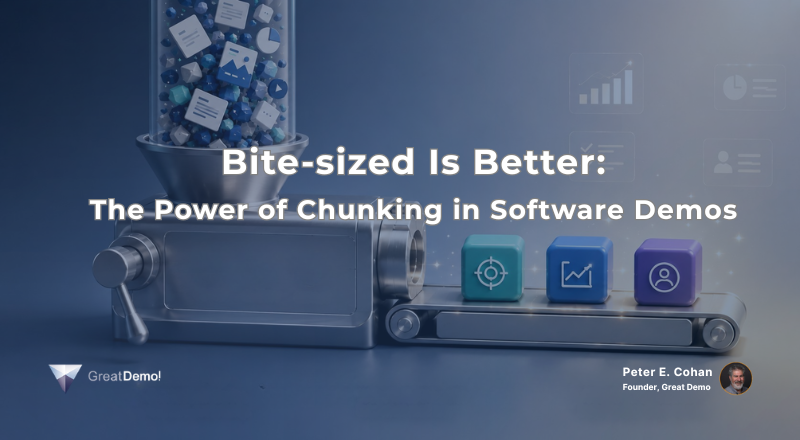
“A wealth of information creates a poverty of attention.”
– Herbert A. Simon
Read this European phone number to a colleague: +49692877693.
How did you present it?
Was it a single non-stop string without any pauses or groupings, or did you break it up into small sections, such as “+49 69 287 76 93”?
Chances are you broke it up into two- or three-number chunks. We do this naturally!
And, if you happened to present the phone number as a single long string, I’ll bet your colleague may have asked you to repeat it, tacitly expecting you to break it up into small, discrete sections.
Why do we break things up this way?
Chunking!
“Chunking makes our brains more efficient. The more you can chunk something, the faster and easier you can process it…”
– Kevin Maney
From Google: “We chunk information to bypass the strict limits of our working memory. By grouping individual pieces of data into larger, meaningful units, we reduce cognitive overload, make content easier to scan, and significantly improve our ability to memorize and process information.”
Very simply, we break things up into smaller components to make them consumable. Eating provides a simple set of analogies, for example. We cut food into bite-size pieces since we can’t fit anything larger in our mouths: This is a physical limitation.
Our brains suffer similar mental limitations. But traditional demos ignore these constraints, confusing prospects and vendors alike. Prospects are told “Now, this is really important…” dozens of times, while vendors don’t understand why prospects are confused.
Contemplate a traditional 1-hour SaaS demo (a stunningly awful Harbor Tour). How many features would you guess are presented? Forty is a good estimate, yet I’ve seen many demos that highlighted a feature per minute. That’s sixty specific ideas the vendor wants their prospect to remember.
That. Is. Impossible!
It’s like pouring a liter of wine into a glass that only holds 150ml: 850ml is wasted. (For folks in the U.S., that’s like pouring a quart of wine into a 5oz glass.) However, you can consume that full bottle of wine over time if you drink five individual glasses (please space this out over a few hours and I’m not responsible for your behavior if you do attempt this experiment!).
At best, your typical human can retain five to seven pieces of information at once. That’s a metaphoric generous glass of wine. Frankly, three ideas are what most people are comfortable with at a time, representative of a more consumable pour.
The point is that if you chunk things in the physical or mental worlds and present those chunks over time (with some additional strategies and tactics, below) you have a much better chance of enabling consumption and retention.
Time?
“You can have it all. Just not all at once.”
– Oprah Winfrey
Just as we need to pace ourselves when eating and pause between bites (teenagers excepted), retention of ideas improves when we give them time to get digested.
It turns out that the typical adult human can pay attention when receiving information for about ten minutes. That’s it. After that, our mental mouth is full; we need time to swallow and process before our next bite.
Now consider: How long are your typical demos? Thirty minutes? An hour?
For an hour-long demo, each mental bite of three (typical) to seven (exceptional) ideas is all you can handle at a time. Accordingly, you’ll need to break up your demo into (at least!) six bites – six chunks – of ten minutes each.
But that’s stretching your audience’s ability to pay attention. Chunks of a few minutes yield stronger engagement and spur a real conversation to take place.
Continuing our dining analogy, note that there are significant pauses between dishes in a multiple course meal. Each course represents a chunk and each bite a tasty, consumable component within that chunk.
But it is the pause, along with conversation and a sip of water that refreshes and enables us to start on the next chunk with our full attention. Let’s examine this more closely!
Losing Attention
“A college professor is someone who talks in someone else’s sleep.”
For those who went to college or university, recall your freshmen or first-year lectures. Large rooms filled with dozens or hundreds of students, often a bit too warm, with the lecturer at the podium beneath a huge screen.
As the class begins you are awake and ready to take notes. The professor presents the topic supported by the occasional slide or graphic. You are following along just fine.
But after a few minutes your mind wanders. Someone comes in late and you all turn to stare while the speaker continues, ignoring the distraction. You miss a section of the talk and glance at a neighbor’s notes to see what they captured. Gratefully, nothing important was lost and you turn your attention back to the podium.
After only ten minutes into the class you realize you’ve checked out. Not intentionally, it’s just that you are struggling to pay attention. And unless the lecturer does something to reengage you, you’ll miss even more of the topic. Ten minutes was all it took.
You need to be refreshed!
Refreshment
“Success is a science; if you have the conditions, you get the result.”
– Oscar Wilde
So, the typical adult human can pay attention for about ten minutes. If you want people to continue to engage, you’ll need to “refresh” them. You need the dining equivalent of a pause, a sip of water or wine, engaging conversation, or even standing up and stretching. What will refresh your audience in a demo?
Summaries serve as excellent vehicles to refresh your audience. Just hearing the phrase, “So, to summarize…” causes people to reengage. (Sometimes I believe audiences are relieved to hear this phrase as it indicates that the presenter is, finally, reaching a conclusion!)
But offering a summary at the end of an hour-long demo doesn’t help along the way.
What’s the solution? Provide interim summaries at the end of each chunk: “So, you just saw the key dashboard you said you need, enabling you to recapture $20,000 annually. Thoughts? Comments? Questions?” And now you pause to give your audience a moment to process and formulate their thoughts.
This combination of a crisp summary and a pause does indeed refresh your audience. In face-to-face demos you may even notice a change in their body language to a more alert posture.
And guess what? Now you’ve earned another ten minutes of attention!
Are there other ways to refresh your audience? Absolutely!
- Questions and comments from audience members: These are some of the most effective refreshment mechanisms. Very importantly, the act of your prospect asking a question or offering an observation increases their ability to remember your key ideas.When they ask a question, they have had to think about it, driving improved retention.
- Props and Visual Aids: Staring at software screens in an hour-long demo is tiring. Using props helps make the intangible tangible! (You can use props in online demos as well as face-to-face. I’ve frequently “handed” people objects via our mutual webcams!)
- Develop ideas on a whiteboard: In face-to-face demos this often requires your audience to physically turn in their chairs, which forces a physical refresh. In both face-to-face and online demos, the act of hovering a pen over an empty whiteboard causes your audience to wonder, “What’s going to be drawn?” That’s a terrific refresh!
- Take a brief break: If you see your audience lagging, invite everyone to stand up and stretch for a moment. They’ll appreciate it, particularly for longer demos. (In Great Demo! Workshops, I would also accomplish this by saying, “OK everyone, take a deep breath…” then wait a moment before adding, “…OK now let it out!”)
- Let your champion drive: This will really wake folks up and is extremely effective in proving ease of use.
- Customer Fill-in: Instead of you choosing options or filling information in a form, invite your prospect to make these decisions. Very effective, very refreshing!
- Stories: Crisp, focused stories will cause your audience to engage and lean in.
- Humor: A well-timed joke (preferably self-deprecating!) can refresh but be aware of cultural constraints!
- Using an agenda or working from a Menu: Both of these enable you to briefly move away from your software to support summarizing your last segment and introducing the next.
- Pauses: In addition to pausing after a summary, modest pauses by themselves can help refresh your prospect.
- Pro tip: Track what appears to work best for you and exchange your findings with your colleagues.
Are breaking your delivery into smaller chunks and refreshing your audience the only ways to improve attention (and retention)? Certainly not!
The Attention-Retention Effect
“It isn’t so astonishing, the number of things that I can remember, as the number of things I can remember that aren’t so.”
– Mark Twain
Studies have shown that when presented with a list of ideas or facts, humans tend to remember the first one or two items quite well. They also recall the last element moderately well.
However, the balance of the list is remembered quite poorly. This suggests that each chunk should focus on no more than three specific ideas.
Even more concerning is how people “remember” information that was never presented! In these same studies, participants frequently invented or synthesized information on their own, yet believed that it had been presented.
Reducing the length of chunks helps to combat this, as does summarizing the (three) key points you want people to remember from each chunk.
But What Is a Good Chunk in a Demo?
“If all the economists were laid end to end, they’d never reach a conclusion.”
– George Bernard Shaw
In Great Demo! methodology, presenting a Situation Slide is a chunk. Presenting an Illustration is a chunk as well. And a Do It pathway is also a chunk, as are each Peel Back the Layers pathways. And note that the methodology prompts you to provide a summary and/or confirmation exchange at the close of each of these.
For those few unfortunates who have never been exposed (gasp!) to Great Demo!, the steps required to complete a simple task is a good candidate for a chunk. Accordingly, a chunk could be as short as a single mouse click, if that’s all that is needed to complete the task: That’s a great chunk!
Completing a typical workflow is also a good candidate for a chunk. But avoid driving yourself into the weeds by presenting “if” and “or” options.
For many SaaS applications, working within a single tab or module provides the outer frame for a chunk. When you move to a new tab or module, you are likely entering a new chunk.
Generally, the shorter the chunk the better. When executing any task or workflow in a demo, think in terms of how your current customers complete them: They use the fewest number of steps or clicks. No extra steps.
Another way to comprehend this is to remember the way you execute your required tasks on a daily basis. Do you add any unnecessary steps when you are working to get things done? Likely not!
Need to update the CRM after a call? That’s a chunk and you complete it with the fewest steps possible. File an expense report? Same process and that’s also a chunk.
Finally, consider breaking up long workflows into logical chunks. Handoffs, between people, systems, or tasks, represent ending and beginning new chunks.
Now it’s time to put these ideas into practice and assess how you are doing. Can you improve your chunking practices?
Speaker Switches Assessment
“Nature gave us one tongue and two ears so we could hear twice as much as we speak.”
– Epictetus
Analyze your demos in terms of the number of Speaker Switches and the length of time between Speaker Switches.
If you see just a handful of Speaker Switches in your demo, then you are overstuffing your prospect, like our food analogy above. If the duration between Speaker Switches is six or eight minutes or (gasp) longer, you are at risk as well.
Your target should be three or four minutes; even shorter is better. This helps your audience stay engaged and pay attention. Practice delivering demo chunks that fit within these constraints and remember to conclude each chunk with a summary.
Pro Tip: Inverted Pyramid
“The inverted pyramid doesn’t bore the reader. It gives them what they want straight away.”
– The Writing Cooperative
Inverted Pyramid, developed by newspeople, organizes and presents information in alignment with how people want to consume it. The most important material is presented first, followed by the next most significant, and so forth.
This enables consumers to explore in as much depth as they desire, without getting bogged down by details. We can (and should!) apply this same approach to demos. Executives only want the headline and the lede; middle managers continue for another paragraph or two, and staff members often want the details.
In demos, you can apply Inverted Pyramid in two dimensions:
- Across the entirety of the demo: Which chunks are most important? Which are secondary? Which can be left out? Inverted Pyramid helps you organize the overall structure of a multi-segment demo to align with your prospect’s interests.
And if you don’t already have your prospect’s priorities from discovery, you can use the Menu Approach to accomplish this on the fly.
- Within each chunk: This enables your audience to explore each topic in as much detail as they have interest.
This demo structure models a news website (or, for the ancient, a newspaper!). The headlines and photos enable you to choose which articles you want to consume. Many of us pursue some articles just that far: the photo and headline. That’s all we want to know.
For other articles, we read a bit further to get more context and development of the topic. And for a few articles, we read most or even all of the text (I hear this most frequently with sports topics!).
Also note that news services offer a Menu of their content: National, International, Politics, Business, Health, Entertainment, etc. The Menu lets you rapidly access the topic(s) of greatest interest to you.
Another Example or Two
“A good example is far better than a good precept.”
– Dwight L. Moody
This article is also organized in discrete chunks, as I’m sure you’ve noticed. Each subhead offers you an opportunity to pause, reflect, and refresh.
And I hope you also noticed that the periodic quotes are designed to accomplish the same goals!
A Final Chunk
So, we’ve explored the importance of chunking in demos to increase engagement and retention. We’ve identified ways to architect chunks and listed several ways to refresh your audience both within and between chunks. And finally, we examined how you can apply Inverted Pyramid across the entirety of your demo and within each chunk.
That’s three key ideas I hope you remember and apply!
Bonus Section: Great Quotes about Chunking
“Nothing is particularly hard if you divide it into small jobs.”
– Henry Ford
“We’re not in a world of information overload, we’re in a world of filter failure.”
– Michael Lazerow
“We live in a world where there is more and more information, and less and less meaning.”
– Jean Baudrillard
“In this age of information abundance and overload, those who get ahead will be the folks who figure out what to leave out.”
– Austin Kleon
“How do you eat an elephant? One bite at a time…” (But please don’t, we need the elephants!)
“A journey of a thousand miles begins with a single step.”
“Rome wasn’t built in a day.”
“Little strokes fell great oaks.” (Again, please be mindful of these beautiful trees…!)
“If you’re overwhelmed by the size of a problem, break it down into smaller pieces.”
“Nothing is particularly hard if you divide it into small jobs.”
Resources:
Great Demo! https://www.amazon.com/dp/B0C9SNKC2Y/
- Chunking – page 239, 249
- Props and Visual Aids – page 376
- The Water Bottles Story – page 313
- The Menu Approach – page 285
- Inverted Pyramid – page 16
- Online Demos – page 306
Let Your Champion Drive
https://greatdemo.com/demo-do-let-your-champion-drive/
Storytelling
The Menu Approach
https://greatdemo.com/the-menu-approach-a-truly-terrific-demo-self-rescue-technique-3/
Customer Fill-in
https://greatdemo.com/customer-fill-in-a-truly-terrific-demo-tip-2/
The Attention-Retention Effect
https://greatdemo.com/leveraging-attention-retention-curves-in-demos/
Inverted Pyramid
https://greatdemo.com/why-structure-demos-like-a-news-article/
Avoiding If and Or
https://greatdemo.com/stunningly-awful-demos-two-words-to-avoid/
Monty Python, “Three shall be the number…”
https://www.youtube.com/watch?v=-IOMNUayJjI
Copyright © 2026 The Second Derivative – All Rights Reserved