
 EN
EN  ES
ES 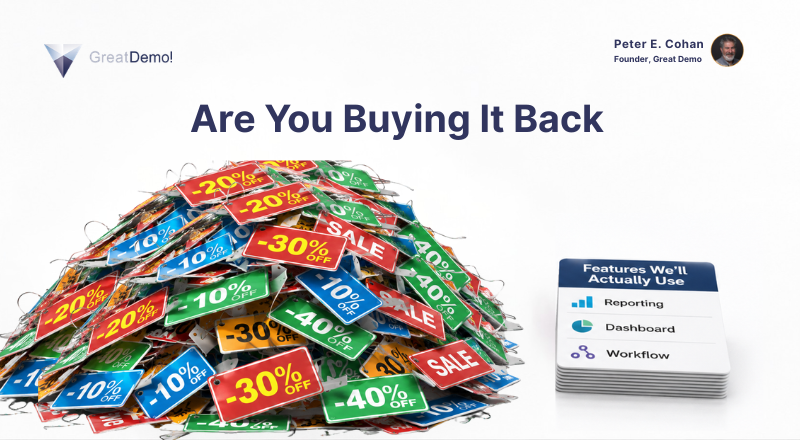
A Painful and Expensive True Story
“We’re gonna need a big discount…” declared the prospect.
“What? Why?” reacted the salesperson, clearly surprised.
“In the demo, you showed us a lot of stuff we’ll never use, and we don’t want to pay for capabilities we won’t use, so either remove those capabilities or cut the price.” stated the prospect.
“But they represent more value…!” the salesperson spluttered.
“Not for us,” was the prospect’s response, “I’d say we’ll use about 30% of what you showed in the demo, so we’ll expect a 70% discount.”
The salesperson’s jaw worked wordlessly and then said, “I’ll see what I can do…”
The deal did close, and the prospect did enjoy a substantial discount.
I remember this story very well, because I was part of the vendor team. In fact, I was the one who presented the demo!
How Much Do You Use?
We all know that we use a small fraction of the software we purchase. Think about your use of Google Docs, MS Office, your CRM system, and other products: what percent of the available capabilities do you actually consume?
A general estimate is twenty percent!
Customer success knows this. Customer service knows this. Product management knows this. Sales and presales know this as well, but somehow that knowledge is often ignored when vendors pitch their wares.
This unforced discounting is known as Buying It Back and it is counterintuitive for most people. After all, the value of your software increases with the number of capabilities included, right?
Nope! The value of your software is based on your prospect’s perceptions of what they’ll use and the nature of the solution it delivers.
In a demo, the more capabilities you show that your prospect doesn’t need, the more you are at risk of Buying It Back. How do you know if you are at risk?
What Prospects Say
If you’ve ever heard these objections, you were probably Buying It Back:
- “We don’t want the Cadillac; we just need a Chevy!”
- “It’s way more than we need!”
- “We don’t need all the bells and whistles.”
- “We’re looking for the bare bones.”
- “A workhorse, not a show horse.”
- “We need utility, not luxury!”
(Folks in Europe, Latin America, Asia-Pacific, and elsewhere, what are the phrases you hear?)
So, if you get these responses after (or worse, during!) your demos, consider how your prospects view their desires vs your feature set.
Wants and Needs
In a traditional demo (and in any demo done without sufficient discovery), each capability you show falls into one of the following categories:
- Must have
- Nice to have
- Neutral
- Don’t need it
- Really don’t need it
The “must have” and “nice to have” capabilities are the Specific Capabilities desired by your prospect. But what about “Neutral,” “Don’t need it,” and “Really don’t need it”? Each time your prospect sees these in your demo they think, “Well, I don’t need that and I certainly don’t want to pay for it.”
And since they have just seen these demonstrated, they know that they will be paying for these features as part of the license fee. One or two small capabilities isn’t much of a risk, but when their perception grows to where there are many features they won’t use then prospects get concerned.
It’s even worse when vendors highlight key differentiators as particularly important or high value, but the prospect has the opposite opinion.
They wonder, “Why should I have to pay for all of these if I’m not going to use them?” And when it is time to negotiate the price and license fees, your prospect says, “You know, you showed us a lot of capabilities that we’ll never use, so you need to reduce your price accordingly. We don’t expect to pay for things we won’t use.”
An Analogy
You are in a restaurant and ask for a glass of wine. Your waiter brings the glass and a full bottle of wine to your table, places the glass in front of you and starts to fill your glass. You are gratified when they fill it right to the top. You are very surprised, however, when they continue to pour! The wine overflows onto the table and then splashes onto the floor. The entire bottle has been emptied, but the only portion you can consume is contained in the glass.
What would you say if the waiter charged you for the full bottle?
Tangible vs Intangible
When you buy something physical like an automobile, you frequently encounter situations where features are bundled. If you want a sunroof on your new SUV, you may have to purchase the “sports package” that includes upgraded wheels and trim, in order to get that sunroof.
You are annoyed that you have to buy the more expensive wheels and trim, but a least they are tangible assets. And if you resell that car in a few years, you can market it by highlighting the upgraded wheels and trim, in addition to the sunroof.
In the world of software, however, all features are intangible! And you have no possibility of recouping the cost of the software with all those capabilities you didn’t want or need by reselling it (unless license agreements have changed markedly!).
Good News
“What they don’t see won’t hurt you!”
There’s a remarkable difference between software and physical products: In software demos, unwanted or unnecessary features can be invisible!
In the world of video and movies they say, “If the camera doesn’t see it, then it didn’t happen…” Interestingly, the same is true for demos. If the prospect isn’t shown capabilities they don’t exist, at least in their minds.
Clearly, this is one of the most important objectives of doing discovery: to understand the Specific Capabilities needed and desired by the prospect. This gives you the list of what should be presented in a demo and the list of capabilities to ignore and leave out.
When you execute effective discovery, you identify exactly which features are “must have” and “nice to have” and plan to show those in your demos. Leaving everything else out of the demo makes the remaining, unwanted capabilities invisible.
What you don’t show, they don’t know!
Intriguingly, we as customers are comfortable with the knowledge that we’ll only use a small fraction of the software products we purchase. We’ve come to accept that using only 20% of the available features is just fine or at least acceptable.
However, this only works when we don’t know about those extra capabilities. When we are forced to see them in a demo is when Buying It Back takes place.
Value?
As noted earlier, most vendors believe that “The more capabilities; the more value…” This is part of the reason vendors traditionally try to pack as many features and functions into demos as possible. These vendors believe that by showing more, the perceived value of their software should similarly increase.
Instead, they are buying it back with every additional click!
This is why traditional “overview” and “end-to-end” demos put you at risk. And organizations that train customer-facing staff to learn their standard “Gold” demos perpetuate the problem. These demos ignore discovery and emphasize vendors’ perceived differentiators.
An Example
Human Capital Management software is a hotly contested space with vendors who often present “hire-to-fire” demos, showing how to:
- Open new hire requests
- Create and post job descriptions
- Review applicant resumes
- Extend offers
- Onboard new hires
- Manage certifications
- Assess employees’ skills
- Provide and track ongoing development
- Execute and track performance reviews
- Identify high performers
- Implement succession plans
- Establish workflows and approvals
- Communicate internally
- Manage time and PTO tracking
- Track employee satisfaction
- Offboard employees
- And more…
Furthermore, many of these vendors’ packages are monoliths: you get everything, even if you don’t need it.
Now imagine that you are the prospect watching this demo and you only need or want three quarters of the functionality presented. The salesperson has stated an annual price of $144K, based on the size of your organization of 120 users at $100 per month. You would arrive at two conclusions:
- This is way more than you need;
- You don’t want to pay for the capabilities you won’t use.
Based on this, how much would you be willing to pay on an annual basis? (Hint: ¾ of $144K is $108K). The vendor’s price is based on the full suite of capabilities, but you will only use 75%. Your argument is irrefutable! The vendor just lost $36K by Buying It Back.
It Gets Worse
The mindset for many demo presenters often compounds the problem and increases the risk of Buying It Back. I frequently hear presenters say at the beginning of a demo, “Stop me if you have any questions – I want to make this interactive.” But they don’t really mean it!
What is going on in the mind of the presenter is often a different reality. They’re thinking, “Please don’t ask any questions! Because if you do, I won’t have time to get through all of the content I want to show…” These demos are typified by truly awful talk-to-listen ratios and infrequent speaker switches.
This mindset of “show as much as possible” results in some of the worst Buying It Back experiences.
Differentiating?
Many sales and presales teams are taught to present their “competitive differentiators” in their demos. In the absence of doing sufficient discovery, your differentiators may actually be negative differentiators!
If you present a key differentiating capability that your prospect needs, that’s a good thing. But what if your prospect doesn’t want that capability? Well, you’ve just differentiated negatively and added that key capability to the Buying It Back list.
Sadly, the trouble often begins before the demo with corporate overview slides that announce, “How We Are Different,” citing capabilities that are differentiators from the vendor’s perspective. Again, if those capabilities are desired by the prospect, you are moving in the right direction. But if they are not needed or wanted, you’ve set the stage for a negative outcome. Presenting those undesired capabilities in the demo completes the Buying It Back drama.
Discovery should be done prior to the demo with a specific focus on your differentiators to determine whether to include them as Specific Capabilities or to rule them out as Buying It Back candidates.
What About Discovery on the Fly?
The tendency of vendors to fall into this self-made Buying It Back trap is huge and happens far too frequently. The temptation to dive further into your software is extremely high once it has been launched! It takes enormous discipline to avoid showing capabilities that the prospect doesn’t need or want (or pay for!).
There are two solutions to avoid Buying It Back when doing Discovery on the Fly:
- Introduce your capabilities in the form of a question before showing them.
If the prospect responds positively, then you can say, “Well, we have that capability – would you like to see it?”
On the other hand, if your prospect’s response is, “No, we don’t really want that….” or “We can’t see situations where that would be valuable,” then you simply move on. Don’t show that capability!
Note that if the negative response happens too frequently, you are still at risk of Buying It Back, since your prospect will begin to assume that all of these capabilities will be in the software they purchase from you, if they move forward.
- Use a Vision Generation Demonstration instead of trying to do traditional Discovery on the Fly. A Vision Generation Demo is designed to satisfy the prospect’s desire to “see what’s possible” while moving the prospect (gently, yet firmly!) into a discovery conversation. (See Chapter 11 in Great Demo! for details.)
The subsequent discovery dialog should yield the list of Specific Capabilities your prospect wants and needs, enabling you to present a Technical Proof Demo that is tailored precisely and avoid Buying It Back. (Chapters 5-9 in Great Demo!)
Summary
Buying It Back is an insidious and often unrealized problem in B2B software demonstrations. Many traditional sales and presales playbooks and processes actually intensify the risk.
Great Demo! methodology helps you successfully avoid Buying It Back outcomes. Vision Generation Demos replace old, ineffective overview demos. Situation Slides help you guide discovery conversations to capture the Specific Capabilities you need to deliver targeted and highly compelling Technical Proof Demos.
Stop Buying It Back…!
Copyright © 2022-2026 The Second Derivative – All Rights Reserved.