
 EN
EN  ES
ES 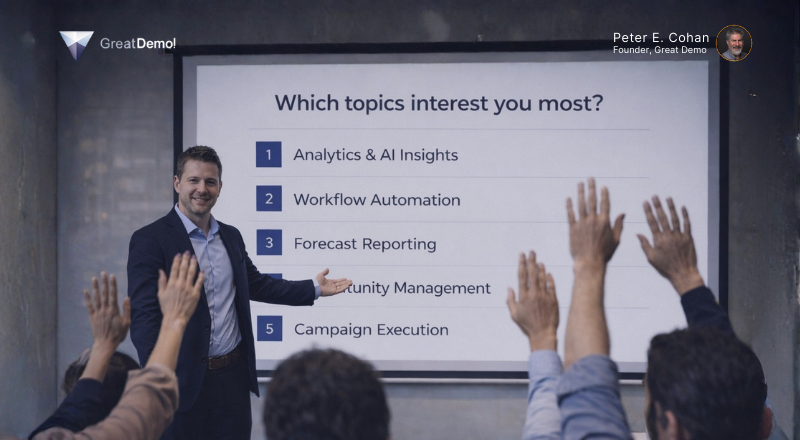
A Never Stop Learning! Article
Have you ever been in a situation where:
- You find yourself in front of an audience you know nothing of their needs or interests – and they’ve been promised a demo?
- You are asked to join a web session, right now, and the salesperson says, “They asked to see a demo…” (and again, you have zero information about the prospect)?
- Someone walks up to you at a trade-show booth and says, “What do you guys do?” or “Show me a demo?”
If so, let me introduce you to a delightful self-rescue technique for situations like these: It’s called The Menu Approach!
It is a logical, simple, and surprisingly effective method for dealing with situations where you don’t know much about your audience and your audience doesn’t know much about you.
Hungry?
Imagine joining colleagues at a nice restaurant that you’ve never been to before.
You sit down and a few moments later a waiter appears and asks, “What would you like?”
You have no idea what they offer, so you respond, “What do you have?”
The waiter says, “Well, we have lots of choices: appetizers, main dishes, side dishes, drinks, and desserts.” The waiter repeats his question, “What would you like?”
You are both making no progress and it is very frustrating!
This is the same situation as in demos where neither party has a clear idea of the other’s desires or capabilities. The result, in many cases, is a stunningly awful Harbor Tour.
Want a much better solution? Use a menu! A menu presents a high-level listing of the range of offerings.
In our restaurant scenario, the waiter says, “Here, let me get you a menu…”
The menu provides a rapid way for the diner to assess what is possible, what sounds good, and what items to consider.
In demos, we can apply the same principle! Simple, elegant, and highly effective.
The Menu Approach – An Example!
Back to situation “1” above…
You’ve been asked to present a demo to a prospect team of a dozen people, about which you know very little. Instead of taking the prospect on a painful and boring Harbor Tour demo, you start by presenting a list of topics that you believe may be of interest.
For a CRM system, a typical list of “menu items” might look like:
- Improving Contact Management
- Analytics and AI Insights
- Workflow Automation
- Opportunity Management and Coaching
- Marketing Campaign Execution
- Forecast and Pipeline Reporting
- Enablement Support
You say, “Here is a list of some topics we could cover. Let me describe each one briefly and then I’ll ask for a show of hands, and each of you can vote for as many topics as you wish.”
At the end of the exercise, your list might look like:
- Improving Contact Management – 5
- Analytics and AI Insights – 12
- Workflow Automation – 10
- Opportunity Management and Coaching – 7
- Marketing Campaign Execution – 4
- Forecast and Pipeline Reporting and Inspection – 11
- Enablement Support – 4
You then re-order to yield a list that is rank prioritized in accord with your prospect’s interests:
- Analytics and AI Insights – 12
- Forecast and Pipeline Reporting and Inspection – 11
- Workflow Automation – 10
- Opportunity Management and Coaching – 7
- Improving Contact Management – 5
- Marketing Campaign Execution – 4
- Enablement Support – 4
Wow! You just accomplished several truly terrific things:
- You’ve uncovered your prospect’s most important issues (they’re at the top of the list).
- You have a roadmap for the balance of your demo.
- You can organize your time to ensure you address the high-importance topics first (and it’s OK if you don’t have time to cover everything on the list).
This third item also takes advantage the Inverted Pyramid structure, a fabulously successful method that enables you to align with your prospect’s depth and level of interest for the topics.
Additionally, you may have also expanded your prospect’s vision of what solutions and solution areas your organization can provide. It is possible that your prospect was previously unaware that you have solutions across this range of topics.
(See “Origins of The Menu Approach: A Demo Survival Success Story” in Suspending Disbelief for a real-life successful example of The Menu Approach! https://tinyurl.com/yc7rsrmy)
A Few Important Subtleties
When counting votes, remember that businesses are not necessarily democracies, and all votes are not necessarily equal! For example, if there is one C-level person in the room, and she is the only one who wants “Marketing Campaign Execution,” that topic moves (magically and mystically) to the top of the list.
Similarly, you can choose to bias the presentation (and subsequent scoring) of topics up or down in accord with your current understanding of your prospect’s situation: “Many of the other customers we’ve worked with in very similar situations to what you’ve shared with us so far found that the topic of “Analytics and AI Insights” was most important. They were able to save months of otherwise wasted effort as a result of what they learned. How many of you are interested in this?”
Finally, when you complete a topic, you can use strike-through text to show that it has been completed, giving you and your prospect a written record of what was completed and what is still open:
- Analytics and AI Insights – 12
- Forecast and Pipeline Reporting and Inspection – 11
- Workflow Automation – 10
- Opportunity Management and Coaching – 7
- Improving Contact Management – 5
- Marketing Campaign Execution – 4
- Enablement Support – 4
Very professional, very elegant!
Next, do menus need to be implemented on-the-fly?
Pro Tip: Be Prepared!
Successful practitioners of The Menu Approach recommend having a menu (or two or three) previously prepared. Their starting point is to create an “uber menu” that includes a fairly long list of topics spanning the full set of expected audience member job titles, markets, verticals, and applications.
Next, they generate subset menus that are aligned with specific verticals and likely prospect interests. These get tuned over time to improve, add, or remove the menu items. It’s like a restaurant, constantly seeking to improve their own menus!
And along those lines, draft your individual topics as solution phrases or problem statements, rather than lists of features.
Next, where else might you find The Menu Approach applicable?
Tradeshows: Dealing with “Show Me A Demo…”
If you have ever worked a demo station at a tradeshow, you are familiar with the prospect who walks up to you and says, “What do you guys do?” or simply, “Show me a demo…” (Clearly, they know not what they ask!).
A solution? Use The Menu Approach! You can have your list of topics available on your demo laptop, computer, or tablet, or consider having a list produced as a poster and attached to the wall of your demo station. You can then simply point to your Menu and begin the same process as above:
“Here is a list of some of the things we do – let me describe each briefly and then you can let me know which ones are most interesting to you.”
Delightful!
Lunch and Learn Sessions
The Menu Approach is also a fabulous method for starting Lunch and Learn sessions. Organize what you plan to present in accord with the results of your Menu review and subsequent poll, starting with the use cases with the most interest (or highest-ranking job titles) and apply the Inverted Pyramid approach. If you run out of time, schedule another session to complete the list!
You can also incorporate your customers’ additional interests in the process. At the beginning of the session, ask “Do you have any specific topics you’d like to explore today?” Include these on your menu (or use them to start the process).
Lunch and Learn demo meetings are terrific vehicles for securing renewals and driving expansion. See more in this article!
Great Demo! Pro Tip: Add Illustrations
I love Korean food, but I have trouble remembering the names of the various items. That’s why I’m always delighted when Korean restaurant menus include small photos of the dishes.
Bulgogi? Got it! Bibimbap? Oh, that’s right! Mandu? Wow, that’s new to me – and they look interesting!
You can apply the same idea to your menus by adding a small image of the main deliverable for each menu item: An Illustration, in Great Demo! terminology. Some folks even generate links from the small image to a full-sized version of the screen.
Great Demo! Pro Tip 2: Vision Generation Demos
The Menu Approach is also the perfect setup and lead into Vision Generation Demos. Extending the idea above, many Great Demo! practitioners generate links from the menu to Situation Slides paired with corresponding Illustrations.
In our Korean restaurant, this would be like choosing a menu item and having your waiter say, “Would you like a small taste?” Delightful and delicious!
The Menu Approach
Many Great Demo! Workshop participants have reported that The Menu Approach is one of the most effective tools they have used. The Menu Approach: a truly terrific demo self-rescue tool for situations where your audience is partly or largely undiscovered.
1Often referred to as a “Chicago-style” vote…
Copyright © 2012-2026 The Second Derivative – All Rights Reserved.
To learn the methods introduced above, consider enrolling in a Great Demo! Doing Discovery or Demonstration Skills Workshop. For more demo and discovery tips, best practices, tools and techniques, explore our books, blog and articles on the Resources pages of our website at https://GreatDemo.com and join the Great Demo! & Doing Discovery LinkedIn Group to learn from others and share your experiences.